|
 |
 |
 |
 |
 |
 |
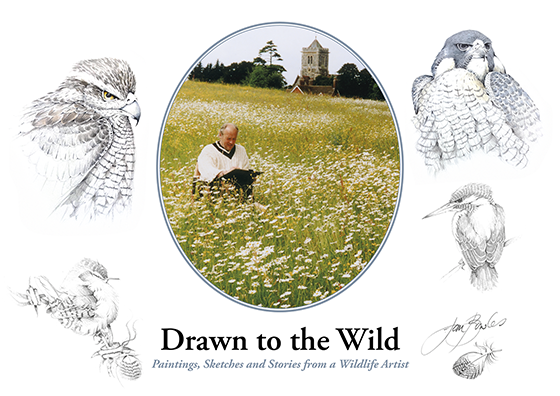
As well as a talented Wildlife Artist my husband Ian wrote regularly for a local magazine, stories of his rambles with his trusty spaniel through our local countryside, of birds and wildlife he encountered. Since his death a few years ago I have been editing these together, illustrated with his sketches and paintings, and with other stories from the Scottish Islands that were a favourite haunt of his, into a book which I have called "Drawn to the Wild". I have self published this through my printers Typecast Colour and now offering it for sale initially to our loyal customers who have purchased calendars and paintings from us over many years.
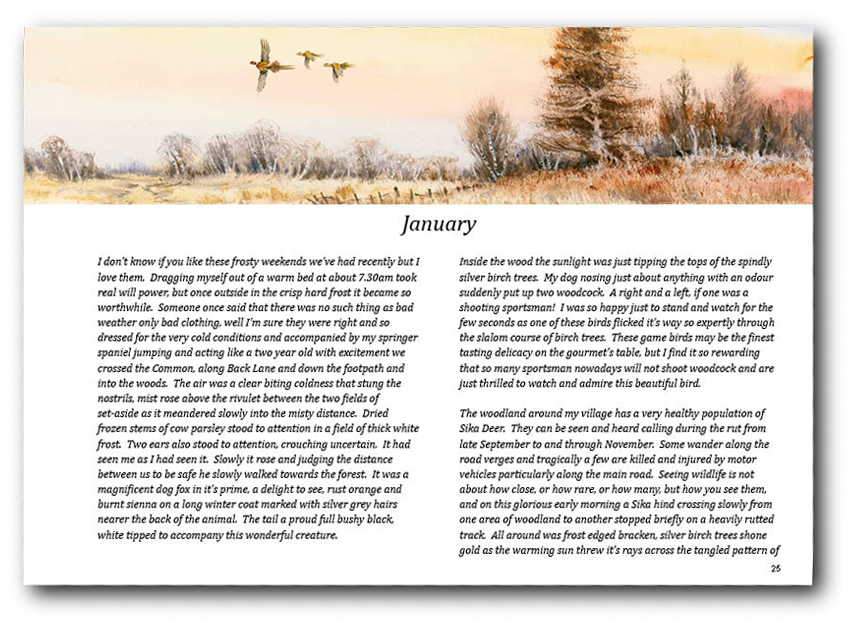
The book is landscape 12" x 8" (300 x 210) 142 pages with over 35 full colour paintings and numerous sketches. It comes in two formats, a laminated soft cover for £25 or a hard back at £35. Postage and packing will be approx £5, and I will be sending these out from October. Let me know if you would like to order a copy by sending me an email with your details. Please do not send me any money at this stage, I will invoice accordingly on dispatch. I have illustrated below a taster of some of the text for your interest.
Susan Bowles

On the very edge of Morvern at Loch Aline, there is a small jetty. Often moored here is a cargo boat, painted red and cream, but always outlined in rust. The smell of grease and coal pervades the air and nobody ever seems to be present. The paint is cracked and peeling and lies thick and pimpled like a sun-burnt skin. Large orange stains drip down from round bolted windows, water pours from outlets and huge sodden ropes secure the vessel to the wooden structure.
Then one morning she is gone. As she materialised, so she disappears, and you are left with the gulls, the creaking timber of the empty jetty, the loneliness and the distant silhouette of the island of Mull.
The visual beauty of Mull is apparent to most visiting the island, but to the artist the real meaning lies in the abstract. To love an island you must fear it, feel cut off, frightened, isolated and haunted by its legends and history. To cross to Mull in deep aquamarine seas, tipped white and running fast with wild greying skies gathering, and darkening, and to cower beneath the proud and fearsome Duart Castle, home to generations of Macleans, and still standing defiant against the coming storm. Huge seas may swallow you and bounce you there, but sometimes when the sky fills black and grey, piercing the thick cloak of soaking cloud, the sun gleams silver and gold, the whole foreground is radiant and the castle is on fire...
The sea lochs of Mull's west coast are warmed by the Gulf Stream, but have been carved in a time of ice. Great boulders of orange-crusted rock drop into pools of swaying kelp that coats the shoreline staining the shell shattered beach with lines of rotting brown decomposition. Here great creatures of red ochre hair idly chew the grasses on the foreshore. Huge horned Highland Cattle slowly lumber along the kelp-strewn beach with only the shaggy rough coated hill sheep for company. The kelp moves to the rhythm of the tide, stalks of blubbery rubber protrude from the clear water of the sea. An arched shape glistens silver amongst the ochre weed. Two dark pools of eyes in a head of muzzled whiskers, then a smaller shape rolls and twists in juvenile fun of play. A female Otter with her cub leave the water, the adult always nervous, the cub still playing, unaware yet of the fear of the wild. They slowly cross the shoreline between the oblivious Highland Cattle and merge into the safety of the sheltering reeds.
The day starts to disappear, great red streaks of colour clash across a sky of darkening blue. In the bay, resting on a black, glistening wet boulder a dog Otter noisily crunches the shell of a shore crab that he has just hunted for. The light is lost quite suddenly, the warmth is gone and a chill returns. A late Curlew continues to pipe its call and high in the hill there is the great guttural roar of the stags.